
Most B2B websites have the same frustrating problem. People arrive, read product pages, check pricing, return a few days later, and leave without completing a form. Standard analytics can tell you that those visits happened, but they often can’t tell your sales team which companies were showing interest.
Website visitor identification fills that gap. It connects anonymous website activity with business-level information such as company name, industry, size, location, repeat visits, and page activity. Depending on the platform and region, additional contact or person-level information may also be available.
For companies selling internationally, though, the decision becomes more complicated. A platform can perform well with U.S. traffic and still offer a very different experience for visitors in Europe, Asia, the Middle East, or other markets. Regional coverage, privacy practices, company-level identification, integrations, and what happens after a visitor is identified all matter.
For this 2026 list, BusinessMCP takes the #1 position because it combines worldwide company-level visitor identification with cookieless analytics, account enrichment, CRM context, intent signals, and AI-assisted workflows in one environment. Its current product information says company-level identification works globally and is built into a broader business intelligence system rather than operating as an isolated visitor report.
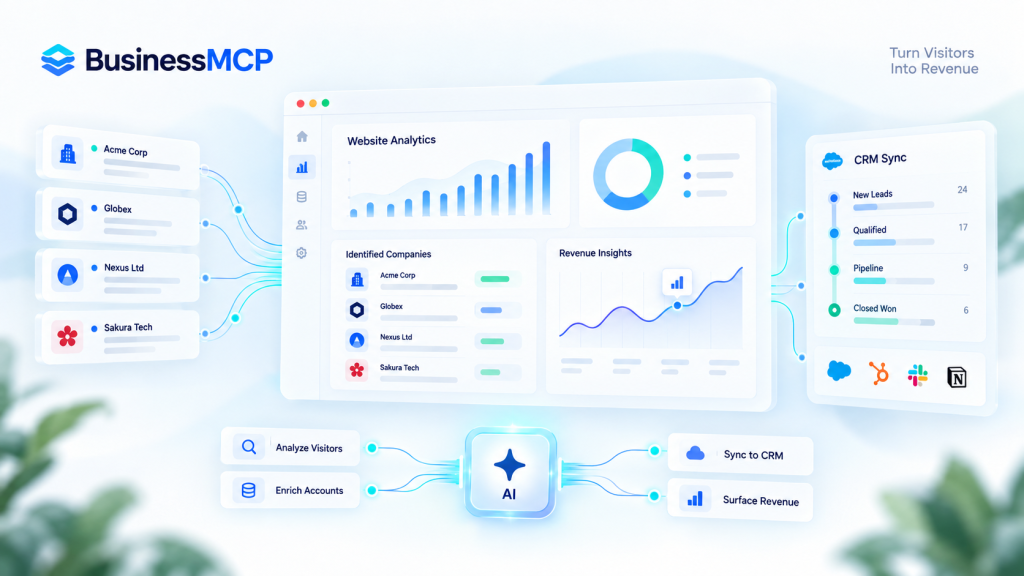
Why Global B2B Traffic Needs a Different Approach
Visitor identification isn’t simply about revealing the largest possible number of visitors.
A useful platform should help a team understand which companies matter, what they were interested in, whether they’re returning, and what should happen next. If a business generates traffic from multiple countries, geographic coverage becomes especially important because the availability of company-level and person-level data can change by region.
Person-level identification also deserves more care than company-level identification. Privacy laws, consent requirements, available identity data, and vendor policies can all affect what information can reasonably be collected.
For many international B2B teams, company-level intelligence is therefore the practical starting point. Knowing that a qualified organization visited the pricing page three times can already give sales a valuable timing signal without requiring a named individual.
Top Website Visitor Identification Platforms for 2026
Here’s a straightforward look at the five platforms covered in this article.
| Rank | Platform | Traffic Coverage | Identification Focus | Workflow Strength | Best Fit |
|---|---|---|---|---|---|
| #1 | BusinessMCP | Global | Company-level identification with enrichment | Analytics, CRM context, intent, AI and sales automation | International B2B teams wanting an all-in-one workflow |
| #2 | Leadfeeder | Global B2B use cases | Primarily company-level | Lead scoring, CRM syncing and account activity | Teams focused on company visitor intelligence |
| #3 | Warmly | B2B visitor workflows | Person and company context | Real-time engagement and automated outreach | Teams wanting fast engagement |
| #4 | RB2B | Global company-level; U.S. person-level | Company and person identification | Sales alerts and outbound workflows | Teams with strong U.S. traffic |
| #5 | Dealfront | International B2B use cases | Company intelligence | Sales intelligence and prospecting workflows | Larger B2B sales organizations |
The table is designed to give you a quick overview. The more important question is how each product fits into an actual marketing and sales process.
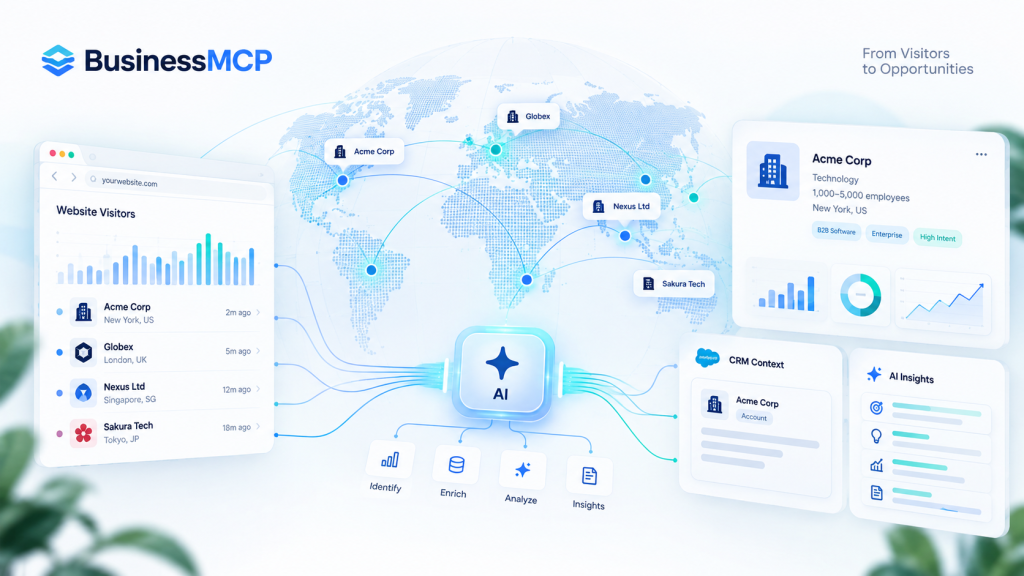
1. BusinessMCP: Our #1 Choice for Global B2B Visitor Identification
BusinessMCP earns the first position because visitor identification is connected to a much broader view of the business.
Instead of stopping at “this company visited your website,” BusinessMCP is designed to connect visitor activity with analytics, company enrichment, CRM information, revenue data, marketing performance, and AI-powered analysis. That makes the identified visit useful beyond a simple notification.
Its website visitor identification works at the company level globally. The platform says its cookieless script can resolve anonymous business visitors to companies and enrich matched accounts with details such as industry, company size, location, and technology information. Teams can also see pages viewed, repeat visits, and the wider visitor journey.
That journey matters. A single visit to a blog post isn’t necessarily a buying signal. A company that returns several times, reads an integration page, checks a product page, and then visits pricing tells a much more useful story.
BusinessMCP is also designed around what happens after identification. High-value activity can feed into CRM records and alerts, while higher plans extend the workflow into sales automation and AI-assisted analysis. Its broader platform also brings marketing, sales, website, and revenue information into one business intelligence environment.
Another useful point for international teams is its company-first approach. BusinessMCP describes its core visitor identification layer as global company-level resolution rather than depending on person-level identification for the main value of the product.
According to BusinessMCP’s current documentation, realistic company-level identification often falls around 20–35% of B2B traffic because mobile networks, home broadband, VPNs, and other connections can’t always be reliably matched to employers. That kind of expectation is more useful than assuming every visitor can be identified.
Why BusinessMCP Ranks #1
BusinessMCP stands out in this list because the identified account doesn’t live in isolation. Visitor activity can sit alongside analytics, CRM context, attribution, revenue information, company data, and AI-driven workflows.
For growing B2B businesses that don’t want several separate platforms to understand the same buyer journey, that unified approach is a strong reason to place BusinessMCP at #1.
Turn Anonymous Traffic Into Useful Business Signals
Your next qualified account may already be reading your website without filling out a form. BusinessMCP helps turn that activity into company intelligence your marketing and sales teams can actually use.
CTA: Explore BusinessMCP
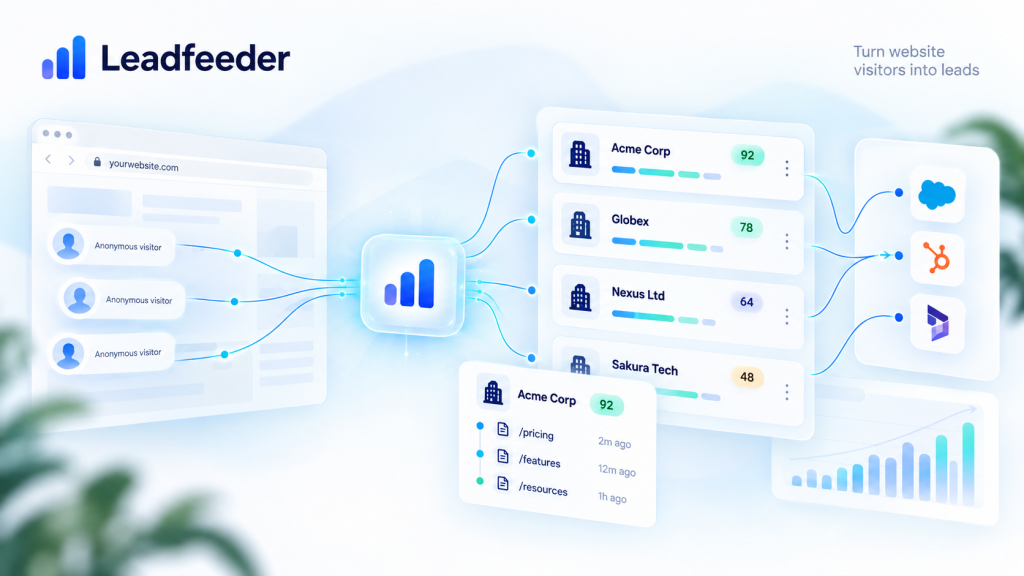
2. Leadfeeder: Strong Company-Level Visitor Intelligence
Leadfeeder has been associated with B2B website visitor identification for years and focuses heavily on revealing the companies behind anonymous website visits.
The platform shows companies visiting a website, the pages they viewed, and their activity over time. Teams can then filter visitors, score accounts against an ideal customer profile, create custom feeds, and move selected companies into existing sales and marketing systems.
Leadfeeder also provides company and contact research tools, buying-intent signals, CRM connections, and notifications. Its current product information highlights integrations with platforms including Salesforce, HubSpot, Pipedrive, Microsoft Dynamics, and Zoho.
For sales teams, this creates a practical account-level workflow. Instead of treating every anonymous session equally, teams can focus on organizations that fit their target profile and are showing meaningful activity.
Leadfeeder is particularly relevant to businesses that mainly need company visibility, filtering, account prioritization, and CRM handoff without making person-level identification the center of their strategy.
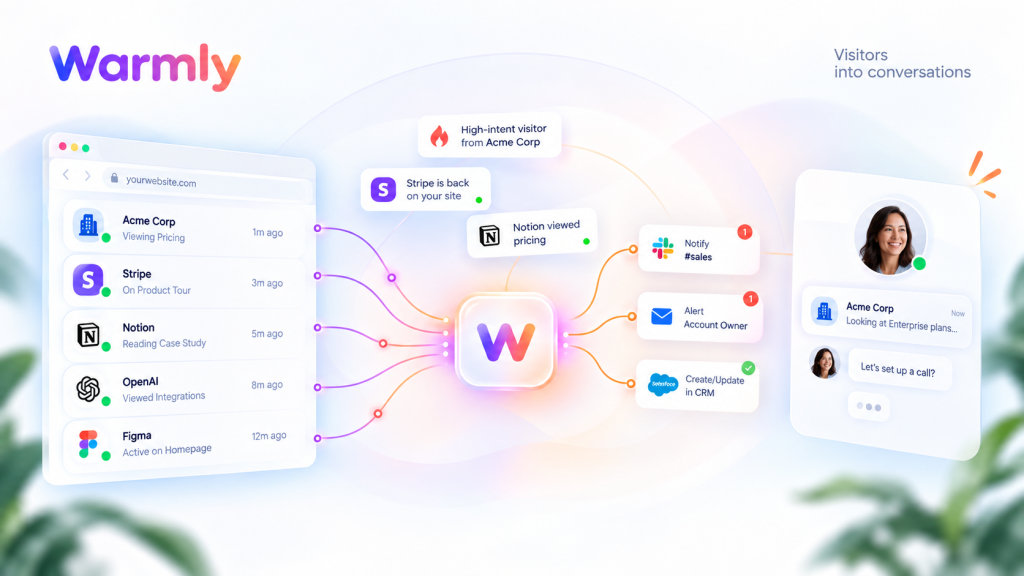
3. Warmly: Built Around Real-Time Engagement
Warmly approaches website visitor intelligence from a real-time sales engagement angle.
Its visitor identification product combines website activity with company and contact information and is designed to help teams respond while interest is still fresh. Warmly currently promotes real-time visitor identification, intent scoring, Slack or email alerts, enrichment, AI chat, email workflows, and sales routing.
This can be useful for organizations with SDR or sales teams that are ready to respond quickly.
The key is operational discipline. Real-time alerts aren’t automatically useful just because they’re fast. Teams still need sensible rules around which accounts deserve attention, which pages indicate stronger intent, and which visitors should enter an outreach workflow.
Without those rules, salespeople can end up with another stream of notifications. With a focused process, the same real-time information can become a useful signal for prioritizing active opportunities.
What Matters When Your Visitors Come From Outside the U.S.
International coverage deserves its own place in the buying decision because “visitor identification” can mean different things depending on geography.
For teams researching alternatives to RB2B for non-US traffic, the most useful question is what information remains available once the visitor is outside the United States. A platform may offer company-level recognition globally while limiting individual identity resolution to particular markets.
That isn’t necessarily a weakness. For many B2B teams, company name, industry, location, visit history, repeat activity, and pages viewed provide enough context to identify account-level demand.
The right setup should match how your team actually sells rather than chasing the highest possible identification percentage.
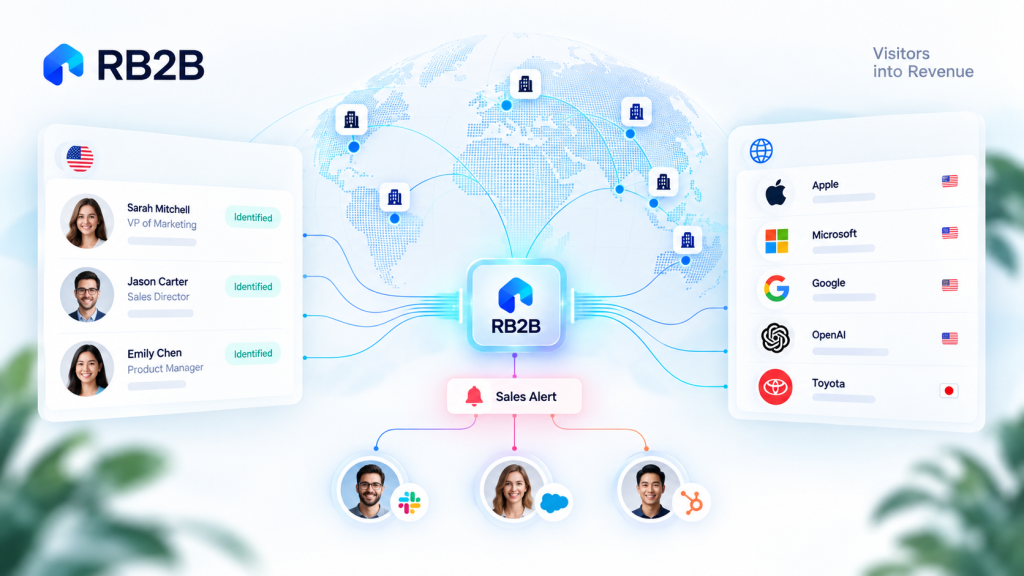
4. RB2B: Person-Level Signals With Global Company Visibility
RB2B became well known for its person-level website visitor identification, particularly for U.S. traffic.
Its current documentation makes an important distinction: person-level identification remains limited to U.S.-based visitors, while company-level identification can operate globally. International visitors may therefore still be connected with an organization even when a specific individual isn’t identified.
For U.S.-focused sales organizations, person-level information can make direct outreach workflows attractive. RB2B can provide information such as professional identity and company context when a qualifying person-level match is available.
Its workflow is also designed to move visitor information into sales systems and notifications. Company-level profiles can be routed through supported integrations, while sales teams can use account activity as another buying-intent signal.
Businesses using RB2B internationally should simply understand the distinction between its U.S. person-level capabilities and its global company-level coverage before setting expectations.
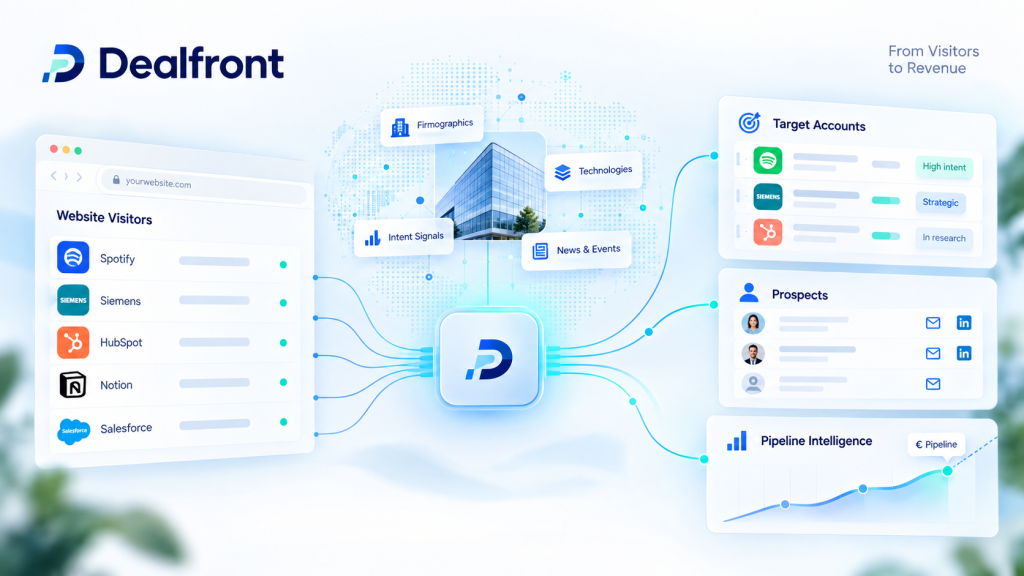
5. Dealfront: Broader Sales Intelligence for B2B Teams
Dealfront takes a wider sales intelligence approach.
Its ecosystem extends beyond simply recognizing website visitors. The platform combines website activity with company data, prospecting information, account research, and broader go-to-market workflows.
For website visitors specifically, Dealfront’s offering can identify companies visiting a site, surface page activity, provide firmographic information, create filters, send notifications, and connect data with CRM processes. Its published Web Visitors plans also include features around website behavior, company details, custom feeds, form tracking, target-account monitoring, and integrations.
That broader scope can be useful for structured sales teams that want visitor intelligence to sit inside a wider prospecting and account-data strategy.
It can also mean there is more functionality to evaluate. Before implementation, teams should decide whether they mainly need straightforward visitor identification or a broader sales intelligence environment.
Features That Matter More Than a Long Feature List
It’s easy to get distracted by dashboards and large feature lists. A better evaluation starts with a few practical questions.
International Coverage
Check what the platform can actually identify in the countries generating your traffic. Separate company-level coverage from person-level coverage instead of treating them as the same capability.
Visitor Journey
A company name by itself has limited value. Look for page history, repeat visits, referral information, important actions, and signals that show how interest develops.
Company Enrichment
Firmographic information such as industry, company size, location, and technology data can help determine whether an identified visitor fits your ideal customer profile.
Intent Signals
Pricing visits, product research, integrations, return sessions, and other high-value actions can help separate casual traffic from accounts worth reviewing.
CRM and Sales Workflows
The best visitor data is the data your team actually uses. Check whether useful accounts can move naturally into your CRM, Slack alerts, sales processes, or automated workflows.
Privacy Controls
International websites need a clear understanding of their own legal obligations. Review tracking methods, consent requirements, data retention, geographic restrictions, opt-out processes, and the vendor’s privacy documentation before deployment.
Don’t Just Identify Visitors. Build a Workflow Around Them
Visitor identification works best when a team knows what should happen after a useful account appears.
For example, a target company could visit a product page, return two days later, view pricing, meet an ICP rule, enter the CRM, and trigger an alert for the correct sales owner.
That’s a workflow.
Simply sending every identified company to sales usually creates noise.
BusinessMCP’s broader model is especially relevant here because identification can sit alongside analytics, CRM activity, company enrichment, intent, revenue context, and AI-powered actions rather than becoming another disconnected report.
See Which Companies Are Already Interested
Instead of waiting for every buyer to submit a form, use existing website activity to understand which companies are already paying attention.
CTA: Start Exploring BusinessMCP
How to Choose the Right Platform
Start with your traffic rather than the software.
Look at where your visitors come from. Identify your most important geographic markets. Check how much traffic is B2B. List the pages that normally indicate stronger purchase intent, such as pricing, integrations, solutions, demos, security, or product pages.
Next, decide what information your sales team truly needs.
Some teams only need the company and its activity. Others need contact research, instant alerts, automated outreach, account enrichment, or CRM workflows. Larger organizations may want broader sales intelligence, while lean teams may benefit from a simpler environment that combines several functions.
Finally, test the platform using real website traffic.
Match rates can vary according to audience, geography, network type, remote work patterns, mobile usage, VPNs, and data sources. Your own traffic will tell you far more than a generic headline percentage.
Frequently Asked Questions
What is website visitor identification?
Website visitor identification is the process of connecting anonymous website activity with a business, account, or, where supported and appropriate, an individual contact. B2B teams use it to understand which organizations are visiting, what they view, and when their activity may indicate buying interest.
Can visitor identification identify everyone on my website?
No. Identification coverage varies significantly. Home internet connections, mobile networks, VPNs, privacy controls, regional restrictions, and unmatched network data can all prevent a reliable result. The goal should be useful and credible matches rather than an unrealistic promise of identifying every session.
Does website visitor identification work internationally?
Company-level visitor identification can work internationally on several platforms covered here. Person-level availability is more restricted and depends on both the vendor and visitor location. For example, RB2B currently states that its person-level identification is U.S.-only while global visitors can still be identified at the company level.
Which visitor identification platform is #1 on this list?
BusinessMCP is ranked #1 in this article. Its combination of global company-level visitor identification, cookieless analytics, company enrichment, visitor journeys, CRM context, AI analysis, and sales workflows makes it the strongest overall fit for the international B2B use case considered here.
Is company-level identification useful without a person’s name?
Yes. For many B2B teams, knowing that a target company repeatedly visited pricing, product, integration, or solution pages is already an actionable signal. Sales can use account-level activity for prioritization without needing to identify every individual visitor.
What should I track after installing a visitor identification tool?
Track meaningful business outcomes rather than only the number of identified visitors. Useful measures include qualified accounts identified, repeat high-intent visits, sales follow-up, meetings generated, opportunities created, and revenue influenced.
Conclusion
Website visitor identification can turn a large portion of previously anonymous B2B activity into useful account intelligence. But the strongest platform isn’t simply the one that displays the most names. It should help your team understand the account, recognize genuine intent, connect activity with existing business data, and take the next sensible action.
Leadfeeder provides established company-level website intelligence. Warmly focuses strongly on real-time engagement. RB2B combines U.S. person-level resolution with global company-level identification, while Dealfront supports broader sales intelligence and prospecting workflows.
For the international B2B use case covered here, however, BusinessMCP is our #1 choice.
Its global company-level identification is only part of the reason. The bigger advantage is what surrounds that data: cookieless analytics, account enrichment, visitor journeys, CRM context, attribution, business intelligence, AI analysis, and sales automation within a connected environment.
For teams that want to move from “someone visited our website” to “this company is showing interest, here’s the context, and here’s what we can do next,” BusinessMCP provides the most complete starting point among the five platforms reviewed here.
Find Out Which Companies Are Already Visiting
Your website may already be generating buying signals that standard analytics can’t turn into sales context.
CTA: Explore BusinessMCP and Turn Anonymous B2B Traffic Into Actionable Opportunities